Braith
The King in YellowBraith is a young painter caught in the siege of Paris, where artistic life survives in bare rooms, hunger, cold, and the continual concussion of cannon fire. He is significant not because the narrative grants him military power or social status, but because his modest resources and unshowy courage turn friendship into material action: he paints in bed to keep warm, accepts help with shame, gives what he can to another impoverished friend, and later helps West rescue Colette from a cellar threatened by bombardment and disorder.
Identity and Circumstances
Braith appears in a nearly empty garret shared with West. The room contains little beyond an iron bedstead, an iron basin, and a pitcher; its austerity makes his poverty concrete rather than merely descriptive. He is painting in bed in order to conserve warmth when Jack Trent enters, and he responds to Trent with laughter and a handshake. The ordinary sociability of that greeting stands against the conditions outside: Paris is frozen, the streets are nearly deserted, and the distant cannon has become the routine answer to inquiries about the siege.
The surrounding city is not a neutral backdrop to Braith’s character. December darkness is cut off by high roofs, cold makes breathing painful, and the streets ring with the metallic sounds of shutters, clogs, and rare voices. Trent encounters a starving gamin searching a sewer for rats, while the bombardment grows from distant muttering into furious thunder. Braith’s life therefore belongs to a social world in which artistic work, domestic shelter, and survival have been forced into the same narrow space.
Friendship and Material Generosity
Braith is initially associated with an exploit devised by West, who has visited a wealthy German-American banker during the siege. The visit exposes the grotesque contrast between the banker’s comfort—fires burning in the anterooms and a banquet laid out beside the hearth—and the deprivation of the artists. West turns the encounter into a comic story, but Braith’s position within it is more vulnerable: he is the poor man whose need makes the joke possible and whose dignity remains at risk.
When Trent presses him to accept assistance, Braith draws a purse from beneath his bolster and hands it over with a simplicity that affects his friend. The gesture reverses the expected direction of charity. Braith is poor, and Trent insists that his own money carries a duty to be shared, yet Braith’s first response is embarrassment and concern that the obligation may never be repaid. His reluctance does not deny friendship; it shows how poverty can make generosity humiliating even when help is freely offered.
Braith’s exchange with Trent also establishes a contrast between economic dependence and moral reciprocity. Trent has the money to distribute, but Braith contributes loyalty, work, and later physical courage. The relationship is not reduced to a benefactor and a debtor. In the besieged city, friendship becomes a circulating resource, and Braith’s acceptance of the purse is paired with his own willingness to act when others are endangered.
From the Artists’ Room to the Cellar
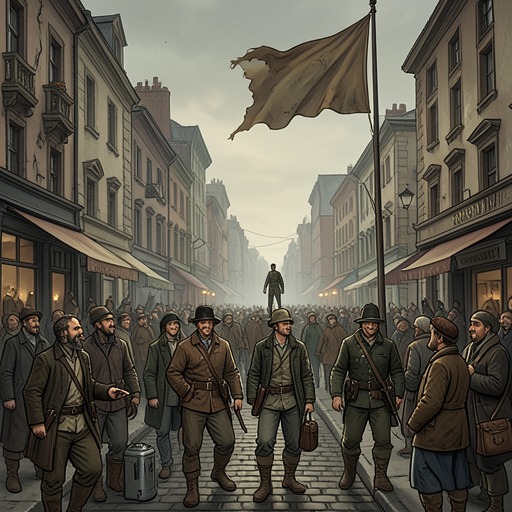
Braith’s next important movement is from the enclosed garret into the dangerous streets. After the battle has failed and the remnants of the army begin returning through the gates of Paris, the city fills with exhausted troops, ambulances, artillery, and civilians. At midnight, the gates remain choked with what was once an army; the crowd watches in silence as hunger, exhaustion, and military collapse enter the city. This atmosphere transforms Braith’s private poverty into part of a larger civic catastrophe.
When Braith reaches West’s cellar, Colette is barricaded below and the concierge has fled to the fortifications. West asks for help, and Braith agrees. The rescue depends on direct physical cooperation: West seizes Colette and leads him toward the light of a barred manhole, then Braith climbs onto West’s shoulders, lifts the cover, crawls out, and raises Colette from below. He twists his legs around a fence chain so that he can lean down again, helping West escape after Colette has grasped West by the collar.
The scene gives Braith a practical heroism without making him grandiose. He is not presented as a commander or a celebrated combatant. His usefulness lies in his body, balance, effort, and readiness to return into danger after reaching safety. Once outside, he replaces the manhole cover and piles stone slabs over it, attempting to conceal the route through which they escaped while fires, shells, and pillagers transform the surrounding streets.
Loyalty Amid Collapse
The escape does not end Braith’s responsibility. West and Braith cross the gardens and move through streets lit only by burning buildings and the flashes of shells. They pass pillagers among the debris and figures whose drunken violence reflects the social disintegration of the city. At the Seine, Braith refuses the security of continuing onward: he says that he must go back because he is not sure about Jack Trent and Sylvia. His decision makes loyalty the governing principle of his conduct, stronger than exhaustion or the immediate relief of escape.
That return is interrupted by the passage of a crowd and a military platoon along the river wall. A lantern reveals Hartman’s deathly face before a volley sounds from the stone parade ground. Around them, fragments of the defeated battle pour through the streets, followed by women and children, while the cry of loss spreads through the city. Braith’s concern for Trent and Sylvia thus occurs at the precise moment when private relationships are being swallowed by military defeat and public panic.
Narrative Role and Significance
Braith serves as a grounded measure of the siege’s human economy. The narrative repeatedly places small acts—painting in bed for warmth, handing over a purse, lifting a companion through a manhole—beside large abstractions such as battle, bombardment, and the collapse of an army. Through him, war is shown not only as an event at the front but as a pressure that tests whether people can share money, shelter, labor, and risk.
His character also complicates the apparent hierarchy of the artists’ circle. Braith lacks wealth and appears ashamed of needing assistance, yet he becomes indispensable when action is required. West supplies initiative and theatrical energy; Trent supplies money and concern; Braith supplies steadiness and physical follow-through. The division is not absolute, but together their different resources form a fragile substitute for the institutions failing around them.
Braith’s arc remains deliberately modest. The evidence does not give him a triumphant public reward or a settled future. Instead, it leaves him defined by repeated choices under pressure: he continues to work despite the cold, accepts help without losing his sense of obligation, assists Colette’s escape, protects the escape route, and turns back because friends may still be in danger. In a city where troops return as a disordered remnant and the streets echo with the recognition of defeat, Braith’s quiet loyalty is one of the narrative’s clearest surviving forms of order.